
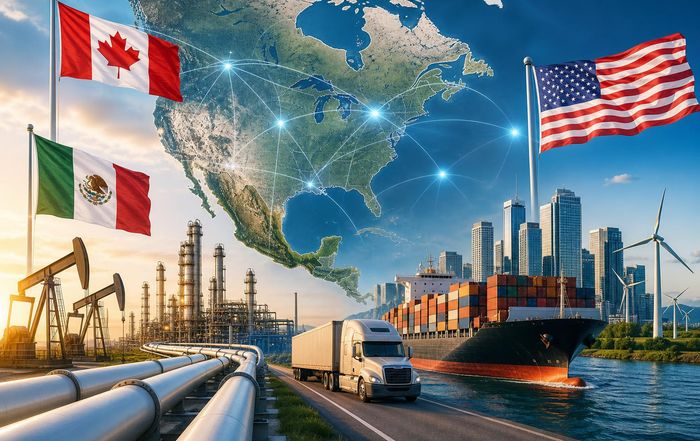
North American Energy Trade and Regional Economic Growth
Introduction: Energy as a North American Growth Engine
North America's energy system has undergone a profound transformation over the past two decades, reshaping trade flows, industrial competitiveness, and regional diplomacy. The interplay between the United States, Canada, and Mexico in oil, natural gas, electricity, and emerging low-carbon fuels has turned the continent into one of the world's most dynamic energy regions. Make sure you read till the end because understanding this evolving energy landscape is essential to interpreting economic trends, investment opportunities, labor market shifts, and regulatory decisions that increasingly define growth prospects across the continent.
The continent's energy story is no longer only about fossil fuel abundance. It is about how integrated infrastructure, cross-border trade agreements, climate policy, technological innovation, and geopolitics are converging to create new patterns of regional economic growth. From the shale basins of Texas and Pennsylvania to the hydroelectric reservoirs of Quebec and British Columbia, and the manufacturing hubs of northern Mexico, energy is functioning as both a traditional commodity and a strategic platform for industrial renewal and clean-technology development.
So let's begin by starting to examine how North American energy trade shapes economic performance in the United States and its neighbors, why cross-border energy flows matter for inflation, jobs, and competitiveness, and how the region is navigating the transition toward lower-carbon systems while preserving energy security. It also highlights the ways in which our growing and active community can follow the evolving story through daily reporting around the economy, business, jobs, regulation, and technology on USA update's economy section and related pages.
The Architecture of North American Energy Interdependence
North America's energy interdependence is rooted in geography, geology, and decades of infrastructure investment. The United States, Canada, and Mexico are bound together by extensive networks of pipelines, transmission lines, and maritime routes that move crude oil, refined products, natural gas, electricity, and increasingly hydrogen and critical minerals across borders.
According to data from the U.S. Energy Information Administration (EIA), the United States remains the world's largest producer of oil and natural gas, while Canada ranks among the top global oil producers and is a key supplier of crude and refined products to U.S. markets. Mexico, historically a major oil exporter, has become more reliant on imports of U.S. natural gas and gasoline even as it seeks to strengthen domestic refining and upstream production. This complex pattern of flows reflects comparative advantages: Canada's vast oil sands and hydropower resources, U.S. shale gas and oil, and Mexico's manufacturing base and proximity to U.S. demand centers.
The Canada Energy Regulator documents that Canada exports the vast majority of its crude oil and a significant share of its natural gas production to the United States, facilitated by major pipeline systems such as those operated by Enbridge and TC Energy. These pipelines supply refineries in the U.S. Midwest and Gulf Coast, underpinning fuel supplies for transportation, petrochemicals, and heavy industry. At the same time, the North American Electric Reliability Corporation (NERC) notes that high-voltage transmission lines move electricity between Canadian provinces and U.S. states, particularly in the Northeast and Pacific Northwest, where imports of Canadian hydropower help balance U.S. grids and support decarbonization.
Mexico's energy ties to the United States are equally significant. The U.S. Department of Energy reports that U.S. pipeline exports of natural gas to Mexico have grown substantially over the past decade, supplying power plants and industry and often displacing more carbon-intensive fuels. Mexico also imports large volumes of U.S. gasoline and diesel, while exporting crude oil to U.S. refineries. These interconnections mean that changes in one country's policies, infrastructure, or demand can reverberate quickly across the region, influencing prices, investment, and economic activity from Alberta to Texas to Nuevo León.
For our loyal visitors following cross-border changes, the continent's energy architecture is central to understanding broader North American and international trends, including trade balances, supply chain resilience, and diplomatic negotiations.
Interactive: North American Energy Trade Snapshot
Explore how the United States, Canada, and Mexico contribute to North American energy interdependence. Use the buttons to switch metrics and tap the country cards for a quick comparison.
Oil and Gas: From Shale Revolution to Strategic Exporter
The North American oil and gas landscape has been transformed by the U.S. shale revolution, which dramatically increased production of crude oil, natural gas, and natural gas liquids. This surge in output has reshaped global trade patterns and turned the United States into a major exporter of both liquefied natural gas (LNG) and refined petroleum products.
Data from the International Energy Agency (IEA) and EIA show that North America collectively ranks as one of the world's largest net exporters of energy, with U.S. LNG exports reaching markets in Europe and Asia, and Canadian crude oil continuing to supply U.S. refineries that are configured to process heavy grades. These exports have taken on elevated strategic importance amid geopolitical tensions and supply disruptions, particularly following Russia's invasion of Ukraine, which led European countries to seek alternative gas supplies. Analysts at organizations such as Columbia University's Center on Global Energy Policy and the Brookings Institution have noted that U.S. LNG shipments have played a stabilizing role in global gas markets, helping to moderate price spikes and reduce vulnerability to Russian pipeline supplies.
The economic impact for North America is substantial. Investment in upstream production, midstream infrastructure, and export terminals has supported high-paying jobs, tax revenues, and manufacturing activity. Regions like the Permian Basin in Texas and New Mexico, the Marcellus and Utica shales in Appalachia, and the Montney and Duvernay formations in Western Canada have become engines of regional growth, with ripple effects on housing, services, and local business formation. For an overview of how these trends intersect with broader U.S. growth patterns, readers can consult USA update's business coverage, which regularly examines corporate investment, regional development, and capital expenditure.
At the same time, the expansion of oil and gas production raises complex questions about climate policy, environmental protection, and long-term energy strategy. Regulatory agencies such as the U.S. Environmental Protection Agency (EPA) and their Canadian and Mexican counterparts have increasingly focused on methane emissions from the oil and gas sector, recognizing methane's high global warming potential. International initiatives, including the Global Methane Pledge, have prompted North American producers to invest in leak detection, flaring reduction, and improved operational practices. These efforts are often supported by advances in digital monitoring, satellite data, and analytics, areas that intersect with the innovation themes explored on the updated technology page.
Electricity, Grids, and the Rise of Cross-Border Clean Power
Electricity trade is a less visible but equally important component of North American energy interdependence. The region's three major grids-the Eastern Interconnection, Western Interconnection, and the Texas-dominated ERCOT system-are linked to Canadian and Mexican networks through cross-border transmission lines. Canada, with its abundant hydropower resources, is a major exporter of low-carbon electricity to the United States, particularly into New England and New York, where imports help meet renewable energy targets and support reliability.
Organizations such as Hydro-Québec and BC Hydro have long exported power southward, and new transmission projects are under development or consideration to expand this trade. Reports from the U.S. Department of Energy's Office of Electricity and independent research from entities like the National Renewable Energy Laboratory (NREL) highlight the role that cross-border transmission can play in integrating higher shares of variable renewable energy, such as wind and solar, by leveraging geographic diversity and flexible hydropower.
Mexico's electricity relationship with the United States is more modest but still significant, particularly in border regions where power exchanges can help manage peak demand, support reliability, or supply isolated grids. As Mexico works to strengthen its generation fleet and grid infrastructure, cross-border connections may become even more important, although policy and regulatory choices will shape the pace and direction of this integration.
The energy transition is accelerating demand for clean power across North America, driven by corporate decarbonization commitments, government policies, and consumer preferences. U.S. legislation such as the Inflation Reduction Act and infrastructure initiatives have catalyzed large-scale investment in renewable energy, grid modernization, and energy storage, with knock-on effects for Canadian and Mexican suppliers of components, raw materials, and services. Readers interested in how these investment waves influence employment and regional development can explore USA update's jobs and employment sections and the top employment coverage, where the intersection of energy, manufacturing, and workforce development is a recurring theme.
Economic Growth, Competitiveness, and Industrial Strategy
Energy trade is not an isolated phenomenon; it is deeply intertwined with North America's broader economic competitiveness and industrial strategy. Reliable, affordable, and increasingly low-carbon energy supplies are critical inputs for sectors ranging from petrochemicals and steel to data centers, electric vehicle manufacturing, and advanced electronics. The relative advantage of North American natural gas prices compared with many other regions has historically supported energy-intensive industries and attracted investment, particularly in the United States Gulf Coast and parts of Canada.
Analyses from the World Bank and OECD highlight how energy costs and reliability influence decisions on where to locate factories, research centers, and logistics hubs. In North America, the combination of domestic resource abundance, integrated infrastructure, and growing clean-energy capacity gives the region a strategic edge, though one that must be managed carefully in light of climate goals and environmental concerns. The expansion of battery manufacturing, electric vehicle production, and semiconductor fabrication in the United States and Mexico, supported by policies such as the CHIPS and Science Act and various state and provincial incentives, is closely linked to the availability of robust and resilient energy systems.
The regional nature of supply chains means that energy policies in one country can affect employment and growth in another. For example, U.S. tax credits for clean technology can stimulate demand for Canadian critical minerals or Mexican manufacturing components, while Canadian and Mexican policies on emissions, permitting, and indigenous consultation can influence the timeline and cost of energy and mining projects that serve North American markets. These cross-border dynamics are increasingly reflected in trade negotiations, investment agreements, and corporate strategies, topics that our news and research team regularly follows in its finance and economy reporting.
Trade Agreements, Regulation, and Policy Coordination
The legal and regulatory framework for North American energy trade rests primarily on the United States-Mexico-Canada Agreement (USMCA), which replaced NAFTA and includes provisions related to energy investment, state-owned enterprises, and dispute resolution. While the agreement does not create a unified energy market, it establishes rules and protections that influence how companies invest in cross-border pipelines, power lines, refineries, and renewable projects.
Policy coordination remains uneven, reflecting different national priorities and political dynamics. The United States and Canada have articulated ambitious climate targets and net-zero emissions goals, while Mexico has taken a more cautious approach to liberalization of its energy sector, emphasizing the role of state-owned entities such as Pemex and the national utility CFE. These differences have at times generated tensions, including disputes over electricity market reforms and the treatment of private and foreign investors, which have been examined by organizations such as the Wilson Center's Mexico Institute and the Council on Foreign Relations.
Regulators play a central role in managing cross-border energy flows. Agencies such as the Federal Energy Regulatory Commission (FERC) in the United States and their counterparts in Canada and Mexico oversee permitting for pipelines, transmission lines, and LNG terminals, evaluate environmental impacts, and set rules for market operation. The growing importance of climate considerations has led to more comprehensive assessments of lifecycle emissions, cumulative environmental effects, and community impacts, which can lengthen project timelines but also aim to increase public trust and environmental integrity.
For readers of USA update, the regulatory dimension is crucial, as changes in permitting rules, emissions standards, or trade policies can have immediate implications for investment decisions, consumer prices, and employment. The platform's independent regulation coverage offers context on how evolving rules in Washington, Ottawa, and Mexico City intersect with broader economic and energy trends.
Employment, Skills, and the Energy Workforce Transition
Energy trade and regional growth are closely linked to labor markets. The oil, gas, power, and clean-energy sectors collectively support millions of jobs across North America, ranging from high-skill engineering roles to construction, operations, maintenance, and professional services. The energy transition, characterized by the gradual shift from fossil fuels to lower-carbon technologies, is reshaping the composition of this workforce, but not necessarily reducing its overall economic significance.
Studies by organizations such as the International Labour Organization (ILO) and International Renewable Energy Agency (IRENA) suggest that clean-energy deployment can generate significant employment in manufacturing, installation, and operations, though the geographic distribution of these jobs may differ from that of traditional oil and gas employment. In North America, regions with strong engineering bases, industrial capabilities, and supportive policy environments are attracting investment in solar manufacturing, wind turbine components, battery plants, and grid infrastructure.
At the same time, communities heavily dependent on oil and gas production face the challenge of managing economic diversification and workforce reskilling. Initiatives in U.S. states like Texas, New Mexico, and Pennsylvania, and in Canadian provinces such as Alberta, aim to leverage existing expertise in drilling, project management, and heavy industry to support emerging sectors like carbon capture and storage, hydrogen, and geothermal energy. These efforts often involve collaboration between industry, governments, unions, and educational institutions.
For individuals and businesses navigating this evolving landscape, USA update's jobs and recommended employment pages offer insights into labor market trends, training programs, and the skills most in demand in the energy and related industries, helping readers anticipate where opportunities are likely to emerge.
Consumers, Inflation, and Energy Affordability
Energy trade has direct consequences for households and businesses through its impact on prices for gasoline, diesel, natural gas, and electricity. The integration of North American energy markets can moderate price volatility by enabling supply to flow to where it is needed most, but it can also transmit shocks across borders when disruptions occur.
Episodes such as extreme weather events in Texas, pipeline outages, or refinery disruptions have demonstrated how quickly regional issues can affect broader markets. Analysis from the Federal Reserve Bank of Dallas and other economic research institutions has shown that energy price spikes can contribute to inflationary pressures, particularly in transportation and heating, with disproportionate effects on lower-income households. Conversely, periods of abundant supply and moderate prices can act as a tailwind for consumer spending and industrial activity.
The inflationary surge observed globally in the early-to-mid 2020s, driven in part by energy price volatility, prompted central banks and policymakers to pay closer attention to the resilience of energy supply chains and the balance between domestic production and imports. In North America, the ability to ramp up production and redirect exports or imports has been an important factor in stabilizing markets. However, as climate policies tighten and investment patterns shift, there is ongoing debate among analysts, including those at the International Monetary Fund (IMF), about how the transition to lower-carbon energy will affect long-term price levels and volatility.
Consumers are also increasingly concerned with the environmental footprint of their energy use, leading to growing interest in electric vehicles, heat pumps, rooftop solar, and energy efficiency. North American policies that support these technologies-through tax credits, rebates, or regulatory standards-can reduce long-term energy bills while also altering demand patterns for oil, gas, and electricity. The evolving consumer landscape, including preferences and purchasing power, is a recurring topic on the consumer page, which connects macroeconomic developments to everyday financial decisions.
Clean Energy, Hydrogen, and the Emerging Low-Carbon Economy
The global push toward decarbonization is opening new frontiers in North American energy trade. Beyond traditional oil, gas, and electricity, attention is turning to hydrogen, sustainable aviation fuels, advanced biofuels, and critical minerals as key components of a low-carbon economy. These emerging sectors have the potential to reshape trade patterns, industrial clusters, and geopolitical relationships.
Hydrogen is a particularly notable example. Reports from the International Energy Agency and Hydrogen Council indicate that North America is positioning itself as a significant producer of low-carbon hydrogen, using natural gas with carbon capture and storage as well as renewable electricity for electrolysis. The United States and Canada have announced strategies and funding mechanisms to support hydrogen hubs, while Mexico's potential lies in its solar resources and proximity to U.S. markets. Cross-border cooperation on standards, infrastructure, and certification will be critical to enabling trade in hydrogen and its derivatives, such as ammonia.
Critical minerals, including lithium, nickel, cobalt, and rare earth elements, are another strategic focus. The shift toward electric vehicles, energy storage, and renewable technologies has increased demand for these materials, prompting North American governments to prioritize domestic and allied supply chains. Canada's mineral resources and Mexico's mining sector, combined with U.S. industrial capacity, create opportunities for integrated value chains that reduce dependence on more distant suppliers. Initiatives involving the U.S. Department of Energy, Natural Resources Canada, and Mexican authorities aim to foster responsible development, environmental stewardship, and community engagement in mining and processing.
These developments intersect with broader trends in sustainable finance and corporate environmental, social, and governance (ESG) commitments, which influence capital flows into energy and resource projects. Financial institutions, guided by frameworks from organizations such as the Task Force on Climate-related Financial Disclosures (TCFD), are increasingly scrutinizing the climate resilience and social impacts of energy investments. For investors, policymakers, and citizens tracking these shifts, USA update's finance section and often cited energy coverage provide a lens on how capital is being allocated and what it means for future growth.
Geopolitics, Security, and North America's Global Role
North America's energy abundance and integrated trade give the region significant influence in global geopolitics. The ability of the United States and Canada to supply oil, gas, and potentially hydrogen and critical minerals to allies has implications for energy security in Europe, Asia, and beyond. As countries seek to diversify away from politically sensitive suppliers, North American exports can offer a more stable alternative, though they must also align with climate goals and domestic environmental expectations.
Think tanks such as the Atlantic Council's Global Energy Center and the Center for Strategic and International Studies (CSIS) have emphasized that energy diplomacy is increasingly intertwined with climate diplomacy, trade policy, and technology cooperation. North American countries are active participants in forums such as the G7, G20, and Clean Energy Ministerial, where they coordinate on emissions reduction strategies, innovation initiatives, and resilience planning. These efforts can reinforce the continent's economic competitiveness by promoting standards and technologies that favor its strengths.
Security considerations also extend to physical and cyber threats to energy infrastructure. Pipelines, LNG terminals, refineries, and power grids are critical assets that must be protected against natural disasters, cyberattacks, and sabotage. Incidents in recent years have underscored the vulnerability of key nodes and the importance of coordinated response plans. Agencies such as the U.S. Cybersecurity and Infrastructure Security Agency (CISA) and their counterparts in Canada and Mexico work with industry to strengthen defenses, share threat intelligence, and develop contingency measures.
For USA update loyal email newsletter members or active website visitors interested in the intersection of energy, security, and international affairs, the platform's completely original news and impartial international pages offer ongoing coverage of diplomatic developments, strategic agreements, and emerging risks that shape the continent's role on the global stage.
Regional Disparities, Environmental Justice, and Community Engagement
While North American energy trade has delivered significant economic benefits, those gains have not been evenly distributed, and the environmental and social costs have often been concentrated in specific communities. Indigenous nations, rural regions, and urban neighborhoods located near refineries, petrochemical plants, or major transport corridors have sometimes borne disproportionate burdens of pollution, land disturbance, and health risks.
Environmental justice has therefore become a central theme in energy policy debates. In the United States, initiatives led by the White House Council on Environmental Quality and agencies like the EPA have sought to incorporate equity considerations into permitting, enforcement, and funding decisions, directing more resources toward historically underserved communities. Canada and Mexico have undertaken their own efforts to strengthen consultation processes with indigenous and local communities, though the effectiveness and consistency of these measures remain the subject of scrutiny by academic researchers, civil society organizations, and affected residents.
Community engagement is increasingly recognized as a prerequisite for successful energy projects, whether fossil fuel or renewable. Companies and governments that invest in transparent communication, benefit-sharing mechanisms, and participatory decision-making are more likely to secure social license and avoid costly delays or conflicts. This shift aligns with broader trends in corporate responsibility and stakeholder capitalism, which emphasize long-term value creation and risk management.
For North American economies, integrating environmental justice and community priorities into energy planning is not only a moral and legal imperative but also a practical strategy for sustaining investment and innovation. Premium websites like USA update, through their lifestyle and news sections, can play a role in highlighting local perspectives, success stories, and lessons learned from projects that balance economic development with environmental stewardship and social inclusion.
Tourism, Events, and the Broader Lifestyle Impact
Energy developments may seem distant from everyday life, yet they influence tourism, events, and lifestyle in subtle but important ways. Regions that benefit from energy-driven prosperity often see increased investment in infrastructure, cultural institutions, and recreational facilities, making them more attractive destinations for visitors and residents alike. Conversely, areas affected by environmental degradation or boom-and-bust cycles can face challenges in building diverse and resilient economies.
As North America invests in clean-energy infrastructure, from offshore wind farms to solar parks and electric-vehicle corridors, new forms of energy-related tourism and educational outreach are emerging. Visitors can tour hydroelectric dams, science museums, and innovation hubs that showcase the continent's technological achievements and sustainability efforts. Major conferences and trade shows focused on energy, climate, and technology draw participants from around the world, generating economic activity for host cities and creating opportunities for knowledge exchange and collaboration.
The integration of energy themes into cultural and entertainment content-through documentaries, films, exhibitions, and festivals-also shapes public understanding and engagement. For readers interested in how these dimensions intersect with regional identity and lifestyle, our team offers daily coverage on events, entertainment, and travel, connecting the energy story to broader narratives about place, community, and quality of life.
Looking Ahead: A Continental Vision for Shared Prosperity
North American energy trade stands at a pivotal juncture. The continent's legacy of fossil fuel abundance, infrastructure integration, and industrial capacity provides a strong foundation, yet the imperatives of climate change, technological disruption, and geopolitical realignment demand adaptation and foresight. The question is not whether energy will continue to drive regional economic growth, but how that growth can be made more sustainable, inclusive, and resilient.
A forward-looking vision would emphasize several interlocking priorities. First, deepening cross-border cooperation on clean-energy deployment, grid modernization, and hydrogen and critical-mineral development can enhance competitiveness while advancing climate goals. Second, aligning regulatory frameworks and trade policies to support innovation and investment, while safeguarding environmental and social standards, can reduce uncertainty and foster long-term planning. Third, investing in workforce development and community resilience can ensure that the benefits of the energy transition are widely shared and that workers and regions in traditional energy sectors are not left behind.
In this evolving context, sites like this play an important role in connecting the dots for citizens, businesses, and policymakers. By covering recent changes across the economy, business, energy, regulation, and international affairs, USA update helps readers see how individual policy decisions, corporate strategies, and technological breakthroughs fit into a larger continental narrative.
As North America navigates the challenges and opportunities of the energy transition, the continent's ability to harness its shared resources, infrastructure, and expertise will be a key determinant of long-term prosperity. Through informed public dialogue, evidence-based policymaking, and collaborative innovation, the region can transform its energy interdependence into a powerful engine for sustainable growth, demonstrating how a diverse and interconnected set of nations can chart a common path toward economic resilience and environmental responsibility.
