
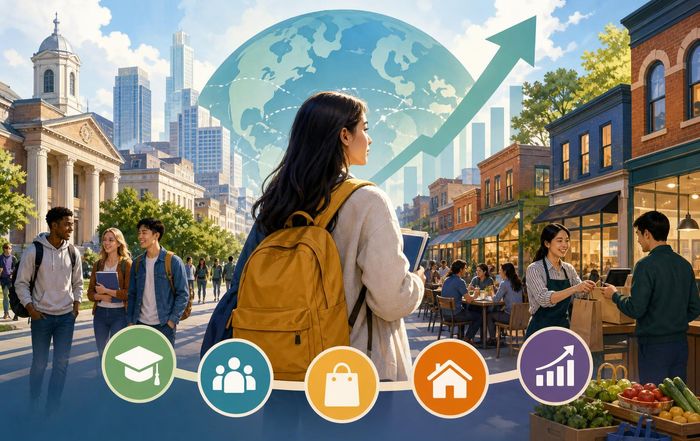
Why International Students Matter Massively to Local and National Economies!
A Major Societal Asset Often Misunderstood by Less Well Educated People
As the United States and its global peers navigate a slower growth environment, persistent inflationary pressures, shifting labor markets, and ongoing geopolitical tensions, international students have emerged as one of the most underestimated drivers of local prosperity. For subscribers and readers of USA update, who follow developments across the economy, jobs, business, regulation, and lifestyle, the role of international students is no longer a niche education story; it has become a core economic, social, and strategic issue that touches almost every major city and university town in the United States, North America, and beyond.
International students bring tuition dollars, consumer spending, research talent, entrepreneurial energy, and long-term trade and innovation links that extend far beyond the walls of the campus. Their presence shapes housing markets, supports local small businesses, fills critical skills gaps in regional labor markets, and strengthens the innovation ecosystems that power sectors from advanced manufacturing to clean energy and artificial intelligence. As policymakers in Washington, Ottawa, London, Berlin, Canberra, Singapore, and other capitals debate immigration rules, visa quotas, and talent strategies, it has become increasingly clear that international students are not simply temporary visitors; they are embedded contributors to the economic fabric of host communities.
For local leaders, employers, and residents following developments on the usa-update.com economy page, understanding why international students matter to local economies is no longer optional. It is a prerequisite for effective planning, competitive positioning, and responsible community development in a globalized, knowledge-driven age.
The Economic Footprint: Tuition, Spending, and Local Multiplier Effects
The most visible contribution international students make to local economies is financial. They pay tuition, rent apartments, buy groceries, use public transit, and spend on entertainment and travel, creating a sustained flow of demand that stabilizes local businesses and public institutions. According to recent data from UNESCO and the OECD, international student mobility has rebounded strongly after the pandemic-era disruptions, with the United States, Canada, the United Kingdom, Australia, Germany, and France among the top destinations. Readers can explore broader trends in global education flows through resources such as UNESCO's education statistics.
In the United States, where many public universities continue to face budget constraints, international students often pay higher, unsubsidized tuition rates, providing critical revenue that supports not only academic programs but also local employment. A substantial share of university operating budgets flows directly into local communities through staff salaries, campus procurement, and construction projects. This creates a multiplier effect: every dollar spent by or because of international students circulates through restaurants, retail outlets, transport providers, landlords, and service firms, generating additional income and tax revenue. Similar dynamics are visible in Canadian cities such as Toronto and Vancouver, in European hubs like Berlin and Paris, and in Asia-Pacific centers such as Sydney, Melbourne, and Singapore.
For a business-oriented audience, the key insight is that international students behave like a stable, recurring customer segment that anchors local demand. In many mid-sized American college towns, international students help sustain a level of economic activity that would otherwise be impossible, especially during off-peak tourism periods or in regions facing population stagnation. Local readers tracking regional developments via the usa-update.com business section can observe that the presence or absence of international students often correlates with vacancy rates, small business survival, and the fiscal health of municipal governments.
Stabilizing Housing, Retail, and Urban Development
International students are also deeply intertwined with local housing markets and urban development patterns. In university cities across the United States, Canada, the United Kingdom, Germany, the Netherlands, and Australia, they represent a significant share of renters, particularly in neighborhoods close to campuses and transit corridors. While this can intensify demand and, in some cases, exacerbate affordability pressures, it also underpins the viability of new residential projects, student housing complexes, and mixed-use developments that incorporate retail, dining, and services.
Urban planners and policymakers must therefore strike a careful balance. On one hand, international students bring predictable rental income that encourages developers to invest in higher-density housing and revitalization projects. On the other hand, insufficient supply or ineffective regulation can lead to overcrowding, rising rents, and community friction. Resources such as the Lincoln Institute of Land Policy and Urban Land Institute provide deeper insights into how student populations influence urban form, land use decisions, and housing affordability.
In cities like Boston, New York, Los Angeles, Toronto, London, Berlin, and Amsterdam, where international enrollments are high, local governments have begun to integrate student housing needs into long-term planning frameworks, zoning reforms, and infrastructure investments. For readers following policy and regulatory debates on the usa-update.com regulation page, the intersection of international student flows, housing regulation, and community planning is becoming a central theme. When managed thoughtfully, the presence of international students can support the development of more vibrant, transit-oriented, and economically diverse neighborhoods that benefit long-term residents as well.
Driving Local Employment and Supporting Small Business Resilience
Beyond tuition and rent, international students sustain employment across a wide range of sectors. Universities, colleges, and language schools directly employ faculty, administrators, support staff, and service providers. However, the indirect employment impact is often even greater, as local businesses expand to serve a growing and diverse student base. Restaurants, cafes, grocery stores, cultural venues, technology repair shops, and travel agencies all benefit from student spending and often adapt their offerings to meet the preferences of international customers from Asia, Europe, Latin America, Africa, and the Middle East.
In many American college towns, the presence of international students has encouraged the growth of multicultural business districts, where Korean, Indian, Chinese, Mexican, Middle Eastern, and African entrepreneurs establish restaurants, supermarkets, and specialty shops. These enterprises not only create jobs for local residents but also contribute to the broader lifestyle appeal of the region, a topic regularly explored in the usa-update.com lifestyle section. Over time, such districts can become destinations in their own right, attracting domestic tourists and fostering cross-cultural understanding.
Economic research from organizations such as the National Bureau of Economic Research and Brookings Institution has highlighted how immigrant and international student communities can boost local entrepreneurship and small business formation. International students, familiar with both their home markets and host-country consumer preferences, are uniquely positioned to identify niche opportunities. When they remain after graduation or maintain business links from abroad, they often become key partners in local export strategies, e-commerce ventures, and globally oriented startups.
Fueling Innovation, Research, and Technology Ecosystems
For technology, science, and innovation-driven regions, international students are not just consumers; they are core contributors to the knowledge base and talent pipeline. In leading research universities across the United States, Canada, Europe, and Asia, international students constitute a substantial share of graduate enrollments in STEM fields, including computer science, engineering, data science, biotechnology, and clean energy. Their work in laboratories, research centers, and collaborative industry projects often underpins breakthroughs that feed into local and national innovation ecosystems.
In the United States, agencies such as the National Science Foundation and National Institutes of Health rely on universities that attract top-tier international graduate students and postdoctoral researchers, who in turn support the research output that drives patents, spin-off companies, and industry partnerships. Interested readers can explore the broader innovation context through resources like NSF's Science and Engineering Indicators and the World Intellectual Property Organization. These students frequently collaborate with local firms, contribute to university-industry consortia, and participate in startup incubators and accelerators, particularly in sectors such as artificial intelligence, quantum computing, advanced materials, and climate technologies.
Cities like San Francisco, Boston, Austin, Seattle, Toronto, Vancouver, London, Berlin, Stockholm, Singapore, Seoul, and Sydney illustrate how international student talent can amplify the competitive advantage of local technology clusters. For readers of the usa-update.com technology page, it is clear that the capacity of a region to attract, integrate, and retain international students is now a critical determinant of its innovation trajectory. When combined with supportive regulatory frameworks, access to venture capital, and robust digital infrastructure, international students help ensure that local economies remain at the forefront of global technological change.
Why International Students Power Local Economies
Explore how tuition, spending, research talent, housing demand, startups, tourism, and global networks flow into city and regional growth.
Impact calculator
Community roadmap
Streamlined visas, strong universities, clear housing plans.
Internships, transit access, student support, local business links.
Post-study work paths, startup support, employer pipelines.
Bridging Labor Market Gaps and Supporting Demographic Stability
Many advanced economies face aging populations, shrinking workforces, and skills mismatches, particularly in sectors such as healthcare, engineering, information technology, and advanced manufacturing. International students provide a partial solution to these structural challenges by entering local labor markets through internships, cooperative education programs, and post-graduation work permits. Countries such as Canada, Australia, Germany, and the United Kingdom have explicitly linked their immigration and higher education policies to long-term talent acquisition strategies, recognizing that students who train locally are more likely to integrate successfully into the workforce.
In the United States, debates continue about the optimal design of visa categories such as F-1, J-1, and H-1B, as well as optional practical training (OPT) programs. Policymakers, employers, and universities understand that restrictive rules risk pushing high-potential graduates toward more welcoming jurisdictions, weakening local competitiveness. Organizations like the Migration Policy Institute and Pew Research Center offer detailed analyses of how international students fit into broader immigration and labor market trends.
For regional economies in the American Midwest, the Canadian Atlantic provinces, parts of Germany and Italy, and smaller cities in Japan and South Korea, international students can help offset demographic decline by contributing to the working-age population, entrepreneurial activity, and tax base. When local employers, chambers of commerce, and city governments coordinate with universities to create clear pathways from education to employment, they can transform international students from temporary residents into long-term contributors who support pension systems, healthcare financing, and community services. Readers tracking employment trends on the usa-update.com jobs page and employment page will recognize that talent shortages in critical sectors increasingly intersect with the capacity to attract and retain international graduates.
Strengthening International Trade, Investment, and Soft Power
The economic impact of international students extends far beyond their time on campus. When they return home or move to third countries, they often become informal ambassadors for the cities and regions where they studied. Their familiarity with local brands, products, services, and business culture can shape trade patterns, tourism decisions, and investment flows for decades. Governments and business organizations have long recognized this phenomenon as a form of soft power that complements formal diplomatic and commercial strategies.
Many global leaders in politics, business, and academia have studied in the United States, the United Kingdom, France, Germany, Canada, Australia, Japan, and other major education hubs. Their positive experiences often translate into favorable perceptions and enduring professional networks that benefit local exporters, universities, and cultural institutions. Resources such as the World Bank and World Trade Organization provide data and analysis on how human capital mobility shapes trade and investment patterns. When former international students rise to leadership positions in their home countries, they may be more inclined to source technology, consulting, and professional services from firms based in the cities where they once lived and studied.
For a platform like usa-update.com, which covers international developments and cross-border dynamics in its international section, the long-term relationships forged through international education are highly relevant. Local economies that successfully integrate international students into their business communities often gain privileged access to emerging markets in Asia, Africa, Latin America, and the Middle East, as alumni facilitate partnerships, joint ventures, and cross-border innovation projects.
Enriching Local Culture, Lifestyle, and Community Resilience
While the focus of this analysis is economic, the cultural and social contributions of international students also carry tangible economic implications. By diversifying local communities, they enhance the attractiveness of cities and regions to both domestic and international visitors, professionals, and investors. Cultural festivals, international film screenings, language exchanges, and student-led events draw residents into new experiences, support local venues, and contribute to the overall vibrancy of the urban environment.
Cities that embrace diversity and inclusion often rank higher in global livability and talent-attraction indices, which in turn influence corporate location decisions and tourism flows. Organizations such as Mercer and the Economist Intelligence Unit regularly assess quality-of-life factors that matter to globally mobile professionals. International students, through their everyday interactions and community engagement, play a subtle but meaningful role in shaping these perceptions. They bring new cuisines, art forms, and social practices that can evolve into enduring features of local culture.
For readers of usa-update.com who follow entertainment and lifestyle trends via the entertainment and lifestyle pages, the influence of international students is often visible in the rise of multicultural festivals, world music venues, global cinema clubs, and fusion food scenes. These developments not only enhance quality of life for residents but also support local creative industries, event organizers, and tourism operators, creating yet another layer of economic impact.
Tourism, Travel, and the Visitor Economy
International students act as anchors in the visitor economy by attracting family and friends who travel to attend graduations, visit during holidays, or explore the region where their relatives study. These visitors stay in hotels, dine in local restaurants, shop at retail outlets, and often extend their trips to other destinations within the host country or region. This dynamic is particularly important for cities and towns that may not be traditional tourist hotspots but gain visibility through their educational institutions.
Tourism authorities and destination marketing organizations increasingly recognize the value of international students as connectors to global visitor markets. By partnering with universities to provide tailored travel information, cultural experiences, and regional tours, they can convert student-related visits into broader tourism flows. Data and insights from entities such as the U.S. Travel Association and the World Tourism Organization (UN Tourism) underscore how education-related mobility contributes to the overall tourism sector, including airline traffic, hospitality, and cultural attractions.
For usa-update.com readers following developments in the travel and events space via the travel and events sections, the linkage between international education and tourism is increasingly evident. Graduation seasons, orientation weeks, and major campus events often coincide with spikes in hotel occupancy, restaurant bookings, and local transportation usage, highlighting the interconnectedness of education, travel, and local economic planning.
Financial Services, Consumer Markets, and Emerging Customer Segments
International students also represent a distinct and increasingly important customer segment for financial institutions, telecom providers, consumer brands, and digital platforms. Upon arrival, many require bank accounts, payment cards, mobile phone plans, health insurance, and digital services. Financial institutions that understand their needs and provide tailored solutions-such as low-fee international transfers, multilingual support, and credit-building products-can establish early relationships that extend into their professional lives, whether they remain in the host country or return home.
Banks and fintech companies in the United States, Canada, the United Kingdom, Germany, Singapore, and Australia have begun to design onboarding processes and products specifically for international students, recognizing that they are often early adopters of digital payment solutions and cross-border financial services. Organizations such as the Bank for International Settlements and International Monetary Fund offer broader context on how cross-border financial flows and remittances intersect with migration and international education.
From a consumer perspective, international students also influence local markets for technology, fashion, food, and entertainment. Their preferences can accelerate the adoption of global brands, streaming services, and digital platforms, while also creating demand for niche products from their home countries. For readers of the usa-update.com finance section and consumer page, the rise of international students as a strategic customer base highlights the need for businesses to segment their markets more precisely and invest in culturally aware marketing and product design.
Policy, Regulation, and the Competition for Global Talent
The economic significance of international students has sparked intense policy debates and regulatory adjustments across major destination countries. Governments must balance concerns about immigration control, labor market impacts, and infrastructure capacity with the clear benefits that international students bring to local economies and long-term competitiveness. In recent years, countries such as Canada and Australia have periodically tightened and then relaxed rules around student visas and post-graduation work rights, responding to public opinion, housing pressures, and labor market conditions.
In the United States, the regulatory environment for international students remains a focal point of discussion among universities, business associations, and policymakers. Issues such as visa processing times, work authorization for spouses, and pathways to permanent residency all influence the country's ability to attract top talent. Analytical resources from organizations like the Council on Foreign Relations and RAND Corporation help contextualize how education, immigration, and national security concerns intersect in these debates.
For readers of usa-update.com who track regulatory developments via the regulation page and broader news coverage, it is clear that the competition for global talent has become a defining feature of 21st-century economic strategy. Regions that adopt evidence-based, predictable, and transparent rules for international students are better positioned to attract investment, foster innovation, and maintain robust local economies. Conversely, jurisdictions that introduce abrupt or restrictive measures risk damaging their reputations, reducing enrollments, and weakening local businesses that rely on student-driven demand.
Regional Perspectives: United States, North America, and Beyond
While the underlying dynamics are global, the specific ways in which international students affect local economies vary across regions and countries. In the United States, large public university systems in states such as California, Texas, New York, Massachusetts, and Illinois have long relied on international enrollments to support research, infrastructure, and community outreach. Smaller institutions in the Midwest and South increasingly view international recruitment as a way to offset domestic demographic decline and enhance campus diversity. The economic ripple effects are visible in local tax revenues, real estate markets, and business formation trends.
In Canada, international students have become central to both higher education finance and immigration policy, with provinces such as Ontario, British Columbia, and Quebec hosting large and growing international populations. Canadian policymakers have sought to harness this trend to address skills shortages and demographic challenges, though recent debates about housing affordability and institutional quality have prompted regulatory recalibrations. Readers interested in broader North American developments can follow related stories on the usa-update.com international section, which often highlights cross-border policy comparisons and regional economic linkages.
Across Europe, countries such as Germany, France, the Netherlands, Sweden, Norway, Denmark, and Finland have invested in English-language programs and scholarship schemes to attract international students, viewing them as catalysts for innovation and long-term competitiveness. The United Kingdom, a traditional leader in international education, continues to refine its visa and work policies to maintain its position amid rising competition from continental Europe and the Asia-Pacific. In Asia, nations like China, Japan, South Korea, Singapore, Malaysia, and Thailand have developed ambitious strategies to both send and receive international students, integrating education into broader plans for regional influence and economic development.
Emerging destinations in Africa and South America, including South Africa and Brazil, are also recognizing the potential of international education to drive local growth and regional integration. For a globally minded audience on usa-update.com, the evolving geography of international student mobility underscores that the economic benefits are not confined to traditional hubs; they are increasingly distributed across a wider range of cities and regions worldwide.
Strategic Implications for Local Leaders and Businesses
Given the breadth and depth of their impact, international students should be viewed by local leaders, businesses, and community organizations as strategic partners rather than passive beneficiaries of local services. Economic development agencies, chambers of commerce, and city governments have an opportunity to more intentionally integrate international students into their planning and outreach efforts. This may involve creating structured internship pipelines, supporting student entrepreneurship, facilitating mentorship programs, and ensuring that local regulations are conducive to part-time work, startup formation, and post-graduation retention.
Universities and colleges, for their part, can strengthen ties with local employers, municipal authorities, and community groups to ensure that international students are not isolated on campus but are embedded in the social and economic life of the region. Initiatives such as industry-sponsored capstone projects, co-op placements, and community-based research can deepen these connections. Organizations like the International Association of Universities and NAFSA: Association of International Educators provide frameworks and best practices for institutions seeking to maximize the mutual benefits of international education.
For businesses, especially small and medium-sized enterprises, engaging with international students can unlock access to linguistic skills, cultural insights, and digital capabilities that are increasingly valuable in a global marketplace. Companies in sectors ranging from manufacturing and logistics to finance, healthcare, and creative industries can benefit from hiring international interns, participating in campus events, and collaborating on applied research projects. Readers who follow the usa-update.com business and economy pages will recognize that, in a competitive and rapidly changing environment, the ability to leverage diverse talent pools is a key differentiator.
Building Trust, Managing Concerns, and Ensuring Sustainability
To fully realize the benefits of international students for local economies, stakeholders must also address legitimate concerns related to housing, infrastructure capacity, integration, and quality assurance. Rapid growth in international enrollments without corresponding investments in student support services, accommodation, and community engagement can strain local resources and fuel public skepticism. Transparent communication, data-driven planning, and inclusive policymaking are essential for maintaining trust and ensuring that the presence of international students contributes to sustainable development.
Local governments and educational institutions should collaborate on impact assessments that track housing availability, transportation usage, employment outcomes, and community perceptions. Publicly sharing this information can help residents understand both the benefits and challenges associated with international student populations. Resources from organizations such as the OECD and UN Department of Economic and Social Affairs can support evidence-based approaches to managing migration and education-related mobility.
From the perspective of usa-update.com, which serves readers interested in regulation, consumer issues, and broader societal trends, the key is to highlight policies and practices that align with principles of Experience, Expertise, Authoritativeness, and Trustworthiness. Responsible coverage of international student issues involves acknowledging community concerns while also presenting rigorous analysis of the economic and social contributions these students make. This balanced approach helps foster informed public debate and supports decision-making at the local, state, and national levels.
Summary Conclusion: International Students as Cornerstones of Local Prosperity
It has become clear that international students are far more than a line item in university budgets or a niche component of immigration policy. They are integral to the economic vitality, innovation capacity, cultural richness, and global connectivity of local communities across the United States, North America, Europe, Asia, Africa, and beyond. Their tuition payments and consumer spending support jobs and tax revenues; their skills and research contributions massively drive technological progress; their networks and experiences strengthen trade, investment, and tourism ties; and their presence enriches the social fabric of the cities and towns they temporarily call home.
For the business-focused, globally aware and well travelled audience of usa-update.com, the message is straightforward: any serious discussion of local economic strategy, workforce planning, or innovation policy must account for the role of international students. Municipal leaders, universities, employers, and community organizations that recognize this reality and act collaboratively will be better positioned to navigate demographic shifts, technological disruption, and geopolitical uncertainty. Those that overlook or underutilize this vital resource risk ceding competitive ground to regions that understand that the classroom, the laboratory, and the local main street are now deeply intertwined with global flows of people, ideas, and capital.
As readers continue to follow developments across the site-from news and economy to business, technology, and international affairs-the evolving story of international students will remain a central lens through which to understand how local economies adapt and thrive in an interconnected world.
