
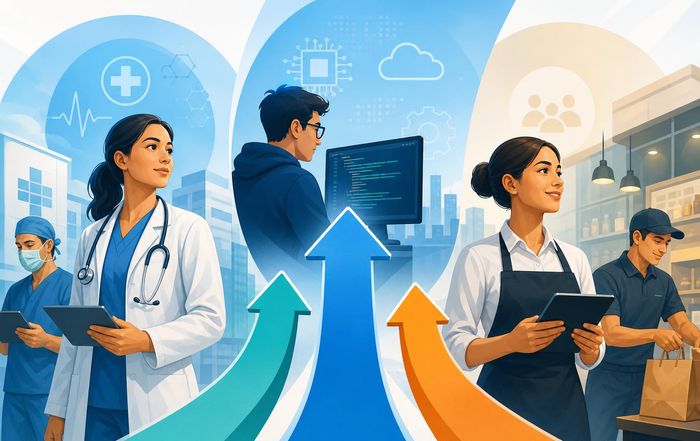
Employment Trends in Healthcare, Technology, and Services
What's The New Shape of Work?
Employment across healthcare, technology, and services has entered a period of structural transformation rather than cyclical fluctuation, and for subscribers and visitors of USA update, this shift is not really an abstract projection but a lived reality influencing career decisions, capital allocation, regulatory priorities, and household well-being. As the United States and other advanced and emerging economies navigate the aftermath of the pandemic era, the acceleration of artificial intelligence, demographic aging, and persistent geopolitical tensions, the labor market has become a primary lens through which business leaders, policymakers, and consumers interpret the broader economic narrative. Within this context, the three sectors of healthcare, technology, and services stand out not only as major employers, but as bellwethers of how work is being redefined in terms of skills, location, security, and value creation.
For a unique, independent, impartial knowledge hubs such as usa-update.com, which tracks developments across the economy, finance, jobs, regulation, energy, and consumer markets, analyzing these employment trends is essential to helping its audience make informed strategic and personal decisions. More and more readers interested in the evolving U.S. economy can explore additional context in the site's dedicated coverage of macroeconomic developments, while those focused on career strategy can connect these sectoral trends with practical insights in its employment and jobs sections. Against this backdrop, the following analysis examines the forces reshaping work in healthcare, technology, and services, with particular attention to the United States and North America, but with a global perspective that includes Europe, Asia, and other key regions.
Macroeconomic and Demographic Drivers of Labor Demand
The trajectory of employment in healthcare, technology, and services cannot be understood without considering the broader macroeconomic and demographic forces at play. The global economy in 2026 is characterized by moderate but uneven growth, with the United States maintaining a position of relative resilience compared with several European economies that continue to grapple with energy costs and demographic stagnation. Organizations such as the International Monetary Fund provide regularly updated assessments of global and regional growth; readers can review current projections and associated labor market commentary through the IMF's analysis of world economic outlook trends.
Demographically, aging populations in the United States, Europe, Japan, South Korea, and parts of China are increasing demand for healthcare services while simultaneously constraining the supply of workers, particularly in occupations that require years of training or specialized certifications. At the same time, younger cohorts in countries such as India, Indonesia, and several African nations are entering the workforce in large numbers, creating both an opportunity and a challenge for global companies that must decide where to locate operations and how to access talent. Data from the United Nations Department of Economic and Social Affairs highlight the pace of population aging and its implications for labor supply, and readers can review these demographic shifts and their projections in the UN's materials on global population dynamics.
Inflation, interest rates, and productivity growth also shape employment patterns. Higher interest rates following the inflationary spike of the early 2020s have moderated speculative investment in some parts of the technology sector, but they have not fundamentally reversed the structural demand for digital skills or cloud-based business models. Similarly, while productivity-enhancing technologies such as generative AI raise concerns about job displacement, they also create new roles in data engineering, governance, and human-machine collaboration. Organizations such as the U.S. Bureau of Labor Statistics continue to publish detailed occupational outlooks, and professionals can examine sector-specific projections in the BLS resources on employment by industry and occupation.
For visitors to usa-update.com, understanding these macro drivers is essential context for interpreting the more granular developments featured in the site's business coverage and international reporting. The interplay between global demographics, monetary policy, and technological diffusion is increasingly visible in day-to-day employment decisions, from hiring freezes in certain corporate offices to aggressive recruitment in others.
Healthcare Employment: Demand Outstripping Supply
Healthcare employment in 2026 is defined by a persistent imbalance: demand for services is rising faster than the available workforce, especially in advanced economies. In the United States, an aging population, increasing prevalence of chronic conditions, and delayed care from earlier pandemic disruptions have combined to raise utilization rates across hospitals, outpatient clinics, and home-based services. At the same time, burnout, early retirements, and insufficient training capacity have contributed to shortages in nursing, primary care, behavioral health, and allied health professions.
Organizations such as the World Health Organization have been warning of global health workforce gaps for years, and their analyses of the health workforce and system capacity underscore how these shortages are not only a U.S. problem but a worldwide challenge affecting Europe, Asia, and Africa. In countries such as Germany, Italy, and Japan, the combination of aging populations and constrained immigration has intensified competition for qualified healthcare workers, encouraging governments and private providers to explore new models of care delivery, including expanded roles for nurse practitioners, physician associates, and telehealth.
Within the United States, major health systems, insurers, and digital health companies are experimenting with new care pathways that blend in-person and virtual care, extend services into the home, and rely more heavily on data analytics to target interventions. The Centers for Medicare & Medicaid Services have played a central role in shaping reimbursement policies that either accelerate or impede these innovations, and stakeholders can review current payment models and value-based care initiatives through CMS resources on healthcare innovation and payment reform. These policies directly influence employment patterns, as organizations adjust staffing to align with new incentives for preventive care, population health management, and risk-based contracts.
For readers of usa-update.com, the healthcare labor market is not only a story about doctors and hospitals but also about the broader economic and regulatory environment that the site tracks in its regulation and consumer sections. The rise of high-deductible plans, the expansion of Medicare Advantage, and ongoing debates about drug pricing all shape how healthcare organizations allocate resources, which in turn determines which roles grow and which are consolidated. In this environment, roles that combine clinical expertise with data literacy, such as clinical informaticists, population health analysts, and telehealth coordinators, have become particularly valuable.
Telehealth, Home-Based Care, and the New Geography of Healthcare Work
One of the most visible changes in healthcare employment over the past several years has been the normalization of telehealth and remote care, a trend that has persisted into 2026 even as many pandemic-era emergency policies have been revised or sunset. While the explosive utilization rates of 2020 and 2021 have moderated, virtual care remains a core component of care delivery strategies, especially for behavioral health, chronic disease management, and follow-up visits. This persistent shift has altered the geography of healthcare work, enabling clinicians to serve patients across wider regions and even across state or national borders where regulations allow.
2026 Healthcare Employment Sectors
Distribution of workforce across key healthcare areas
Organizations such as Kaiser Permanente, Mayo Clinic, and Cleveland Clinic have invested heavily in virtual care infrastructure, and their experiences have influenced industry standards worldwide. The U.S. Department of Health and Human Services continues to update guidance on telehealth flexibilities and cross-state practice rules, and stakeholders can follow these developments through HHS materials on telehealth policy and access. These regulatory frameworks directly affect employment opportunities, as clinicians who might previously have been constrained to local markets can now participate in multi-state or even international telehealth networks, while rural and underserved communities gain access to specialists who would otherwise be unavailable.
At the same time, home-based care models, including hospital-at-home programs and remote patient monitoring, are creating new categories of employment that blend clinical, logistical, and technological responsibilities. Nurses and allied health professionals increasingly work in hybrid roles that require proficiency with remote monitoring devices, digital triage tools, and care coordination platforms. Technology companies specializing in remote monitoring, such as Philips Healthcare and Medtronic, have expanded their hiring of clinical liaison roles and data analysts to support these models, and their corporate updates often highlight how digital tools are reshaping clinical workflows. Industry observers can learn more about the evolution of connected care through resources from Philips on remote monitoring and telehealth solutions.
For usa-update.com, whose audience spans both healthcare professionals and business decision-makers, these developments intersect with broader themes in technology coverage and employment analysis. The convergence of clinical work and digital platforms demands new training pathways, updated licensing frameworks, and robust cybersecurity practices, all of which introduce both opportunities and risks for employers and workers.
Technology Employment: From Boom-Bust Cycles to Structural Integration
The technology sector in 2026 is no longer viewed purely through the lens of standalone "tech companies," but rather as a pervasive layer embedded across every industry, from manufacturing and logistics to finance, retail, and government. While the early 2020s saw high-profile layoffs at several large technology firms, particularly in social media and consumer internet services, the underlying demand for software engineering, cybersecurity, cloud architecture, and data science has remained strong, albeit more disciplined and tied to demonstrable business value.
A central driver of technology employment has been the rapid adoption of artificial intelligence and machine learning, including generative AI tools that can create text, code, images, and other content. Major platforms from Microsoft, Google, Amazon Web Services, and OpenAI have catalyzed both excitement and concern across the labor market, as organizations experiment with AI-assisted workflows while grappling with governance, bias, and intellectual property issues. Business and technology leaders can explore the broader implications of AI adoption through resources from McKinsey & Company on the economic impact of artificial intelligence.
As AI systems become more capable, the nature of technology work is shifting from purely technical implementation toward higher-order tasks involving problem framing, integration, and ethics. Software engineers are increasingly expected to work alongside AI-assisted coding tools, focusing on architecture, security, and complex system design rather than routine boilerplate. Data scientists and machine learning engineers are being asked to collaborate with legal, compliance, and domain experts to ensure responsible deployment. This evolution is prompting universities and professional training organizations to revise curricula, emphasizing interdisciplinary skills that combine technical depth with domain knowledge in fields such as healthcare, finance, and energy.
For readers following the U.S. and North American tech landscape through usa-update.com, the sector's employment story intersects with broader economic and regulatory trends covered in the site's technology and news sections. Policy debates over data privacy, antitrust enforcement, and AI regulation are shaping where and how technology companies invest and hire, while ongoing competition with Europe, China, and other regions is driving government initiatives aimed at strengthening domestic innovation ecosystems.
Cybersecurity, Cloud, and the Resilience Imperative
Another defining feature of technology employment in 2026 is the centrality of cybersecurity and cloud infrastructure to organizational resilience. High-profile cyber incidents affecting critical infrastructure, healthcare systems, and financial institutions have underscored the importance of robust security postures, prompting both public and private sector organizations to expand their cybersecurity teams and invest in continuous monitoring, incident response, and employee training. The Cybersecurity and Infrastructure Security Agency (CISA) in the United States has become a key reference point for best practices and threat intelligence, and professionals can access guidance on cybersecurity workforce development and risk management.
Cloud computing, once considered an optional modernization initiative, is now viewed as a foundational utility for most enterprises, and this shift has created sustained demand for cloud architects, site reliability engineers, DevOps specialists, and FinOps analysts who manage the financial aspects of cloud usage. The major cloud providers, including Amazon Web Services, Microsoft Azure, and Google Cloud, continue to expand their training and certification programs to address skills gaps, while many enterprises are building internal "cloud centers of excellence" that serve as hubs for best practices and governance. Industry observers can explore the evolving role of cloud in digital transformation through analysis from Gartner on cloud strategies and IT infrastructure.
For usa-update.com readers focused on business continuity and risk management, these technology employment trends connect directly to concerns about regulatory compliance, consumer trust, and competitive advantage. The site's business and finance coverage often highlights how cyber incidents can impact valuations, insurance costs, and customer loyalty, reinforcing the notion that cybersecurity and cloud expertise are not merely technical specializations but strategic assets.
Services Sector Employment: The Expanding Universe of Intangible Work
The services sector, encompassing everything from retail and hospitality to professional services, logistics, and digital platforms, remains the largest employer in the United States and many other advanced economies. In 2026, employment in services is being reshaped by several overlapping forces: the normalization of hybrid work, the rise of platform-mediated labor, shifting consumer expectations, and the integration of automation and AI into frontline and back-office operations.
Professional and business services, including consulting, legal, accounting, and marketing, have seen steady demand as organizations seek guidance on digital transformation, ESG reporting, regulatory compliance, and cross-border expansion. Firms such as Deloitte, PwC, EY, and KPMG have expanded their offerings in technology consulting, cybersecurity, and sustainability, leading to new roles that blend traditional advisory skills with data analytics and sector-specific expertise. Analysts and executives can explore broader trends in professional services and knowledge-intensive work through research from the World Economic Forum on the future of jobs and skills.
At the same time, consumer-facing services such as retail, hospitality, and travel have experienced a complex recovery pattern. While pent-up demand has supported growth in leisure travel and dining, labor shortages, wage pressures, and changing consumer behavior have accelerated the adoption of self-service technologies, mobile ordering, and automated logistics. This has led to a bifurcation in employment: routine, low-wage roles are more susceptible to automation or restructuring, while positions that involve complex customer interaction, problem-solving, or creative service design remain in demand. Companies that can combine digital convenience with personalized human interaction are better positioned to attract both customers and employees.
For usa-update.com, whose audience is interested in travel, lifestyle, and consumer trends as well as business and employment, these service sector dynamics are central to understanding how cities, regions, and entire industries are evolving. The interplay between automation, customer experience, and workforce development will continue to shape not only job counts but also the quality and meaning of work in services.
Hybrid Work, Remote Collaboration, and Global Talent Markets
One of the most persistent legacies of the pandemic era is the normalization of hybrid and remote work in many white-collar occupations, especially in technology, professional services, finance, and parts of healthcare administration. By 2026, many organizations have moved beyond ad hoc remote arrangements toward more structured hybrid models, often requiring employees to be on-site a certain number of days per week while allowing flexibility for the remainder. This shift has significant implications for employment geography, real estate markets, and international talent competition.
Companies across North America, Europe, and Asia are increasingly willing to hire remote talent from other regions, provided that legal, tax, and data security considerations can be managed. This trend has opened new opportunities for professionals in countries such as Canada, Brazil, Poland, India, and the Philippines to work for U.S. and European firms without relocating, while also intensifying competition for local candidates. Organizations such as LinkedIn, Indeed, and Glassdoor have become critical platforms for connecting employers and job seekers in this more fluid environment, and their labor market reports provide ongoing insight into remote work trends and skills demand. Professionals can explore the evolving landscape of remote and hybrid work through LinkedIn's analysis of global talent trends.
However, the normalization of hybrid work is not without challenges. Managers must adapt to leading distributed teams, maintaining culture and cohesion, and evaluating performance when visibility is lower. Employees must navigate boundaries between work and personal life, manage digital overload, and ensure they remain visible for advancement opportunities. These complexities have given rise to new roles in employee experience, workplace analytics, and organizational development, as companies seek to design work environments that balance flexibility with engagement and productivity.
For the audience of usa-update.com, which spans industries and geographies, hybrid work is not merely an HR topic but a strategic consideration that influences everything from commercial real estate investments to regional economic development plans. The site's economy and events coverage increasingly reflects how conferences, trade shows, and networking activities are blending in-person and virtual formats, reshaping the very concept of professional interaction.
Skills, Reskilling, and the Education-Employment Nexus
As employment in healthcare, technology, and services evolves, the alignment between education and labor market needs has become a central concern for policymakers, employers, and individuals. In 2026, the traditional model of front-loaded education followed by a linear career is giving way to a more dynamic pattern of continuous upskilling and reskilling, often delivered through modular, online, and employer-sponsored programs. This shift reflects both the accelerating pace of technological change and the growing recognition that many high-demand roles do not require conventional four-year degrees but rather specific competencies and certifications.
Organizations such as the World Bank and the Organisation for Economic Co-operation and Development (OECD) have emphasized the importance of human capital development for inclusive growth, and their research on skills for the future of work highlights the need for stronger partnerships between educational institutions, employers, and governments. In practice, this has led to the expansion of apprenticeship programs, bootcamps, and micro-credentialing initiatives in fields such as software development, data analytics, cybersecurity, and advanced manufacturing, as well as new pathways into healthcare roles such as medical assistants, community health workers, and care coordinators.
Within the United States, community colleges, state universities, and private training providers are increasingly collaborating with employers to design curricula that reflect real-world requirements, often supported by federal and state funding. The U.S. Department of Labor has played a role in promoting apprenticeship and workforce innovation, and stakeholders can access information on these initiatives through DOL resources on employment and training administration. These efforts are particularly important for supporting workers in transitioning from declining roles, such as certain routine administrative positions, into growing fields that offer higher wages and more stable career trajectories.
For readers of usa-update.com seeking to navigate these shifts personally, the site's jobs and employment coverage can serve as a bridge between macro-level analysis and individual decision-making, highlighting which skills are most in demand, which sectors are hiring, and how workers in different age groups and regions are adapting.
Regulation, Ethics, and Trust in the New Labor Landscape
Employment trends in healthcare, technology, and services are not determined solely by market forces; they are also shaped by regulatory frameworks, ethical norms, and societal expectations. In 2026, questions of data privacy, algorithmic fairness, labor rights, and professional standards are central to debates about how work should be organized and rewarded. Governments in the United States, the European Union, the United Kingdom, and other jurisdictions are grappling with how to regulate AI, protect workers in platform-based gig arrangements, and ensure that cross-border employment does not circumvent labor protections.
The European Commission has taken a prominent role in developing AI and data protection regulations, and its initiatives have global implications due to the extraterritorial reach of frameworks such as the General Data Protection Regulation and emerging AI rules. Stakeholders can follow these developments through the Commission's materials on digital strategy and AI governance. In the United States, regulatory efforts are more fragmented, involving agencies such as the Federal Trade Commission, Equal Employment Opportunity Commission, and sector-specific regulators, but there is growing momentum around guidelines for AI in hiring, healthcare, and financial services.
Ethical considerations also loom large in healthcare employment, where questions of patient privacy, informed consent, and equity intersect with the deployment of digital tools and data-driven decision systems. Professional bodies such as the American Medical Association and American Nurses Association continue to update their codes of ethics to address telehealth, AI-assisted diagnostics, and remote monitoring, emphasizing the need to preserve patient trust and clinician autonomy. Healthcare professionals and policymakers can explore these evolving standards through the AMA's resources on ethics and emerging technologies.
For usa-update.com, whose regulation coverage tracks how laws and rules affect businesses and workers, these developments underscore the importance of staying informed about policy changes that can reshape employment practices. Trustworthiness in this context is not only a matter of compliance but also of public perception; organizations that are perceived as exploiting workers or mishandling sensitive data risk reputational damage that can affect their ability to attract both customers and talent.
Regional Perspectives: United States, North America, and Beyond
While this analysis has emphasized global trends, the specifics of employment in healthcare, technology, and services vary significantly by region, reflecting differences in economic structure, regulatory regimes, cultural norms, and demographic profiles. In the United States, the combination of a large domestic market, advanced research ecosystem, and flexible labor regulations has fostered dynamic growth in technology and healthcare innovation, albeit with persistent challenges related to inequality, access to education, and regional disparities between coastal hubs and interior regions.
Canada and Mexico, as key partners in North American supply chains, have seen their own employment landscapes evolve in response to nearshoring, trade agreements, and sectoral specialization. In Europe, countries such as Germany, France, and the Netherlands are investing heavily in green technologies, advanced manufacturing, and digital infrastructure, while grappling with aging populations and energy transition challenges. In Asia, China, India, South Korea, Singapore, and Japan each present distinct employment narratives, from China's efforts to balance technological self-reliance with global integration, to India's role as a major provider of IT and business process services, to Singapore's focus on high-value professional and financial services.
Emerging markets in Africa, Southeast Asia, and Latin America are increasingly central to global employment strategies, both as sources of talent and as growing consumer markets. Organizations such as the International Labour Organization provide comparative data and analysis on labor market conditions across these regions, and readers can explore these insights through the ILO's resources on global employment trends. For multinational companies and investors following usa-update.com, these regional differences are not abstract; they influence decisions about where to locate operations, how to structure supply chains, and how to manage cross-border teams.
Strategic Implications for Businesses, Workers, and Policymakers
By 2026, the employment trends in healthcare, technology, and services are converging around several strategic imperatives that affect businesses, workers, and policymakers alike. For businesses, the capacity to attract, develop, and retain talent in critical roles has become a core source of competitive advantage, often more decisive than access to physical capital or natural resources. This reality is driving investments in employer branding, learning and development, diversity and inclusion, and flexible work arrangements, as organizations recognize that skilled professionals have increasing choice and mobility.
For workers, the imperative is to cultivate a portfolio of skills that combine technical competence with adaptability, communication, and problem-solving. In healthcare, this may mean integrating digital literacy and population health concepts into clinical training; in technology, it involves pairing coding or data skills with domain expertise and ethical awareness; in services, it requires blending customer empathy with comfort using digital tools. The shift toward continuous learning can be challenging, particularly for mid-career professionals and those in regions with limited access to high-quality training, but it also offers opportunities for career reinvention and upward mobility.
For policymakers, the central challenge is to create an enabling environment that supports innovation and productivity while ensuring that the benefits of growth are broadly shared. This involves investing in education and infrastructure, updating labor and social protection systems to accommodate new forms of work, and fostering collaboration between public and private actors. It also requires careful calibration of regulation in areas such as AI, data privacy, and healthcare reimbursement, balancing the need for oversight with the risk of stifling beneficial innovation.
Readers of usa-update.com can expect these themes to remain prominent across the site's economy, business, finance, and international coverage, as employment trends continue to serve as a barometer for broader societal and economic change. The site's role in synthesizing complex developments and presenting them in a clear, actionable manner contributes to the broader ecosystem of information that individuals and organizations rely on to navigate an increasingly uncertain world.
Do we Know How we'll be Navigating the Next Phase of Work?
As the world spins around, floating as a tiny blue spec in the middle of gigantic universe, back here on Earth employment in healthcare, technology, and services will continue to evolve in response to technological breakthroughs, demographic shifts, regulatory changes, and geopolitical events. While it is impossible to predict every twist in this trajectory, several underlying patterns are likely to persist. The integration of AI into everyday workflows will deepen, raising ongoing questions about the division of labor between humans and machines. The demand for healthcare services will remain robust, driven by aging populations and rising expectations for quality and accessibility. The services sector will continue to grapple with balancing efficiency and personalization, automation and human touch.
In this environment, the most resilient organizations and individuals will be those who approach work not as a static set of tasks but as a dynamic process of learning, adaptation, and value creation. For businesses, this means building cultures that encourage experimentation and cross-functional collaboration, while grounding real earth-based decision-making in data and hopefully ethical reflection. For workers, it entails cultivating curiosity, seeking out new skills, and engaging proactively with emerging technologies rather than resisting them. For policymakers and civic leaders, it requires sustained investment in institutions and frameworks that support both innovation and inclusion.
For the earth based community :) of USA update, these employment trends are not distant universal abstractions but immediate forces shaping careers, investments, and community life. By continuing to monitor developments across healthcare, technology, and services, and by connecting macro-level analysis with concrete examples and practical insights, the platform can help its readers not only understand the future of work but also participate actively in shaping it. In doing so, it contributes to a broader ecosystem of informed discourse that is essential for building economies and societies that are both dynamic and fair in the years ahead.
